
Average Acceleration Calculator
Average acceleration is the change in velocity divided by the time taken. Enter the initial and final velocity and the time, in the units you have, and the calculator gives the acceleration in m/s² and ft/s² with the equivalent g-force and the working shown. Switch the unknown to solve for final velocity, time or initial velocity instead.
- Free to use
- No sign-up
- Runs in your browser
Quick answer
Average acceleration is the change in velocity divided by elapsed time: a = (v − v₀) / Δt. Enter initial velocity, final velocity and time; the calculator converts velocity units, then reports acceleration in m/s², ft/s² and g-force. If a vehicle goes from 0 to 60 mph in 8.0 s, its average acceleration is 3.35 m/s², or 0.34 g.
Average acceleration calculator
Kinematics Formula & Practice Pack
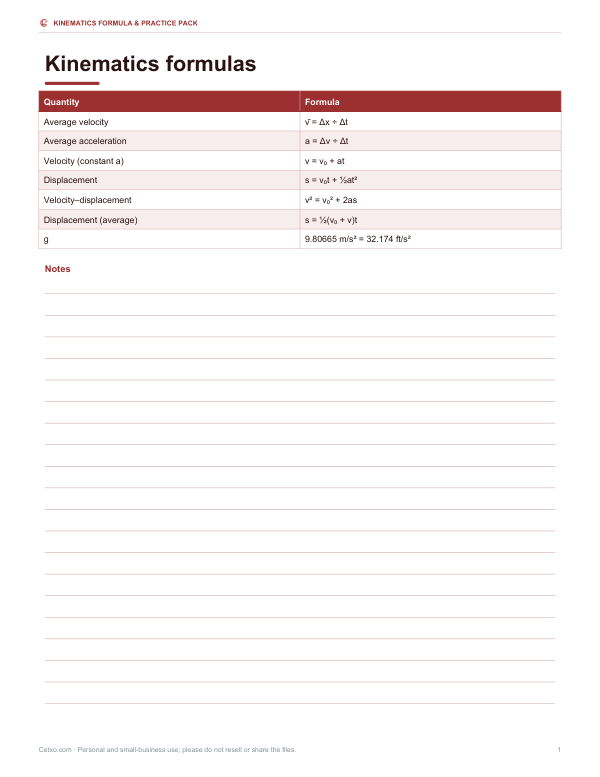
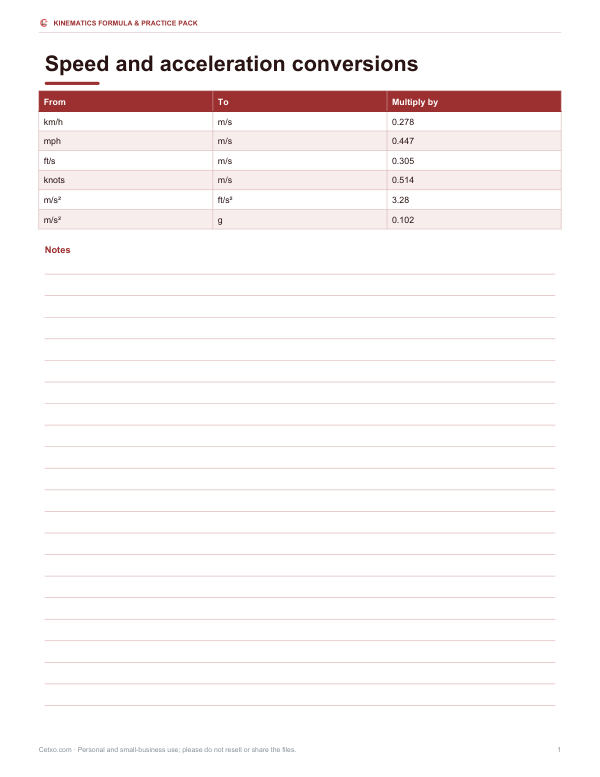
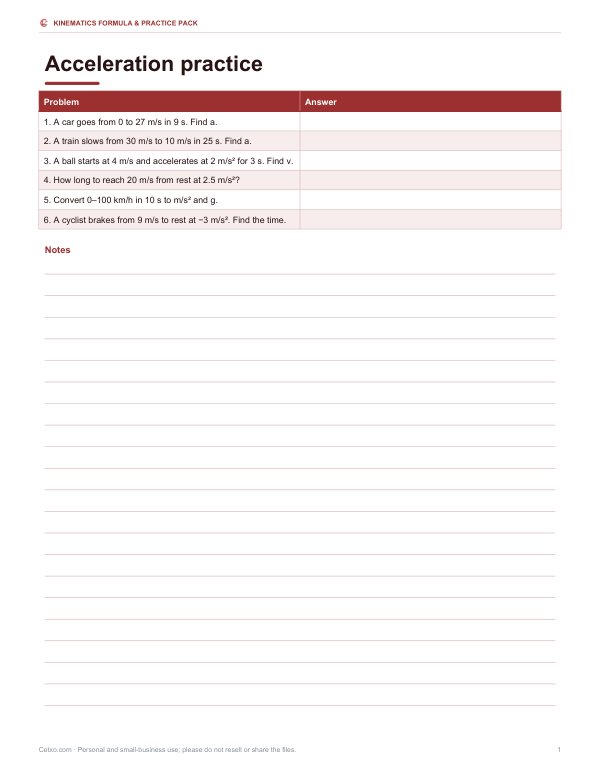
Printable kinematics formula sheet, unit conversion card, 20 practice problems on acceleration and motion with full worked solutions, and a lab data sheet.
- Formula sheet (PDF)
- Unit conversion card (PDF)
- Practice problems with solutions (PDF, DOCX)
- Lab data sheet (PDF, DOCX, XLSX)
Formats: PDF, DOCX, XLSX. Instant download after payment (link valid 72 hours, up to 5 downloads). AI-assisted: the templates were drafted with AI help and reviewed and laid out before publishing.
$5.00 USD, one-time 4 files · about $1.25 each
- Instant download
- 7-day refund
- Secure checkout by Stripe
7-day money-back guarantee. Full refund within 7 days of purchase, even after you download.
Free sample: Acceleration Practice Problems (PDF, 101 KB)
Full refund within 7 days — see the refund policy and license.
Free printables
Single sheets you can print right now, no sign-up. The full pack adds every sheet in one download plus the editable files.
 Printable Motion Lab Data Sheet
Average acceleration equations
Use these rearranged formulas depending on which value you need to find.
| Solve for | Formula | Input units | Result |
|---|---|---|---|
| Acceleration | a = (v − v₀) / Δt | velocity, time | m/s² |
| Final velocity | v = v₀ + aΔt | velocity, accel, time | m/s |
| Initial velocity | v₀ = v − aΔt | velocity, accel, time | m/s |
| Time | Δt = (v − v₀) / a | velocity, accel | seconds |
| g-force | g = a / 9.80665 | m/s² | g |
| ft/s² | ft/s² = m/s² × 3.2808 | m/s² | ft/s² |
The average acceleration formula
Average acceleration is the change in velocity divided by the time over which it happens: a = Δv ÷ Δt = (v − v₀) ÷ (t − t₀). In SI units, velocity is in metres per second and time in seconds, so acceleration is in metres per second per second (m/s²). An acceleration of 3 m/s² means the velocity increases by 3 m/s every second. Because velocity has direction, acceleration does too: slowing down in the direction of motion gives a negative acceleration, sometimes called deceleration.
How to use the calculator
- Choose what to solve for — usually acceleration.
- Choose the velocity units you have: m/s, km/h, mph, ft/s or knots. The calculator converts to m/s internally.
- Enter the initial and final velocity and the time taken in seconds.
- Read the acceleration in m/s² and ft/s², the g-force and the working.
- To find final velocity, time or initial velocity instead, change “Solve for” and enter the acceleration.
Worked example: a car accelerating
A car goes from 0 to 60 mph in 8.0 seconds. Converting, 60 mph = 26.82 m/s, so a = (26.82 − 0) ÷ 8.0 = 3.35 m/s², which is about 11.0 ft/s² or 0.34 g. The same calculation for a car that takes 4.0 seconds gives 6.71 m/s², or 0.68 g — a sensation of being pushed firmly into the seat.
Worked example: braking
A cyclist travelling at 8 m/s brakes to a stop in 2.5 seconds. The average acceleration is (0 − 8) ÷ 2.5 = −3.2 m/s². The negative sign shows the acceleration is opposite to the direction of motion. To find how long it would take to stop from 12 m/s at the same rate, solve for time: (0 − 12) ÷ (−3.2) = 3.75 s.
Unit conversions
| From | To m/s multiply by |
|---|---|
| km/h | 0.27778 (÷ 3.6) |
| mph | 0.44704 |
| ft/s | 0.3048 |
| knots | 0.51444 |
For acceleration, 1 m/s² = 3.2808 ft/s², and 1 g (standard gravity) = 9.80665 m/s² = 32.174 ft/s².
g-force comparisons
Standing still on Earth you feel 1 g from gravity. Typical everyday car acceleration is around 0.2–0.4 g; hard emergency braking on dry roads can reach roughly 0.8–1 g. Passenger lifts accelerate at a small fraction of g. Roller coasters are designed to stay within limits set by engineering standards, and trained pilots experience several g in tight turns. These are typical figures for context rather than precise values.
Average vs instantaneous acceleration
Average acceleration describes the whole interval. Instantaneous acceleration is the acceleration at one moment — the slope of the velocity–time graph at a point. A car accelerating from rest usually accelerates hardest at first and less as speed rises, so its average over 0–60 mph hides those changes. If acceleration is constant, average and instantaneous acceleration are the same, and the constant-acceleration equations (v = v₀ + at, s = v₀t + ½at², v² = v₀² + 2as) apply.
Acceleration from a velocity–time graph
On a velocity–time graph, average acceleration between two moments is the slope of the straight line joining the two points: the rise (change in velocity) divided by the run (change in time). A steeper line means greater acceleration; a horizontal line means zero acceleration (constant velocity); and a line sloping down means negative acceleration. The area under a velocity–time graph gives the displacement, which links acceleration to distance travelled.
Acceleration and force
Newton’s second law connects acceleration to force: F = m·a. A 1,500 kg car accelerating at 3.35 m/s² needs a net forward force of about 5,000 newtons. The same law explains why heavier vehicles accelerate more slowly with the same engine force, and why seat belts and crumple zones matter: stopping quickly means a large deceleration, and therefore a large force on the occupants.
Common mistakes
- Mixing units — for example km/h for velocity and seconds for time without converting.
- Using speed instead of velocity when direction changes.
- Forgetting the negative sign for slowing down.
- Dividing by total time when the velocity change happened over a shorter interval.
- Confusing acceleration (m/s²) with velocity (m/s).
Acceleration in everyday life
Acceleration is part of daily experience. You feel it as a push back into the seat when a car or train speeds up, a lurch forward when it brakes, and a sideways pull on a bend — turning at constant speed is also acceleration, because the direction of velocity changes. Lifts feel heavier as they accelerate upward and lighter as they slow at the top. Engineers design vehicles, lifts and rides to keep these accelerations comfortable, typically well below 1 g for passengers in everyday transport.
Privacy
All calculations run in your browser; nothing is stored or uploaded.
Frequently asked questions
How do I calculate average acceleration from mph and seconds?
Convert mph to m/s by multiplying by 0.44704. Then subtract initial velocity from final velocity and divide by the time in seconds.
Is 0 to 60 time an average acceleration?
Yes. A 0 to 60 mph time gives the average acceleration over that interval, but the vehicle’s actual acceleration can be higher or lower at different speeds.
How do I convert average acceleration to g-force?
Divide the acceleration in m/s² by standard gravity, 9.80665 m/s². For example, 3.35 m/s² is about 0.34 g.
What is the formula for average acceleration?
a = (v − v₀) ÷ Δt: change in velocity divided by time.
What are the units of acceleration?
Metres per second squared (m/s²) in SI; ft/s² in US customary units.
Can acceleration be negative?
Yes. It means the acceleration points opposite to the chosen positive direction, often slowing down.
How do I convert acceleration to g-force?
Divide by 9.80665 m/s².
What is 0–60 mph in 6 seconds in m/s²?
About 4.47 m/s², or 0.46 g.
Is my data stored?
No, it runs in your browser.
Is deceleration the same as negative acceleration?
In everyday use, yes: slowing down. In physics, the sign depends on which direction you call positive.